
A therapist finishes a full day of sessions, then opens three more systems to catch up on notes, reminders, assessments, and billing. That is where most conversations about AI for therapists should start - not with hype, but with the real workload that piles up around care.
For behavioral health teams, the question is not whether AI sounds impressive. It is whether it can reduce friction without interfering with clinical judgment, privacy standards, or the therapeutic relationship. The best use of AI in therapy settings is practical, narrow, and supervised. It helps clinicians prepare, document, and stay organized so they can spend more of their attention on patients.
Where AI for therapists fits in real practice
Therapy is built on nuance, context, and trust. That makes behavioral health a poor fit for careless automation and a strong fit for carefully designed support. AI should not diagnose, decide risk on its own, or replace a therapist’s reasoning. It should make it easier to run a connected practice and follow what is happening between sessions.
That distinction matters because many clinicians are already dealing with fragmented workflows. Scheduling lives in one place, billing in another, intake forms somewhere else, and patient follow-up often depends on memory or manual effort. In that environment, even a useful AI feature can become one more disconnected tool if it is not built into the workflow.
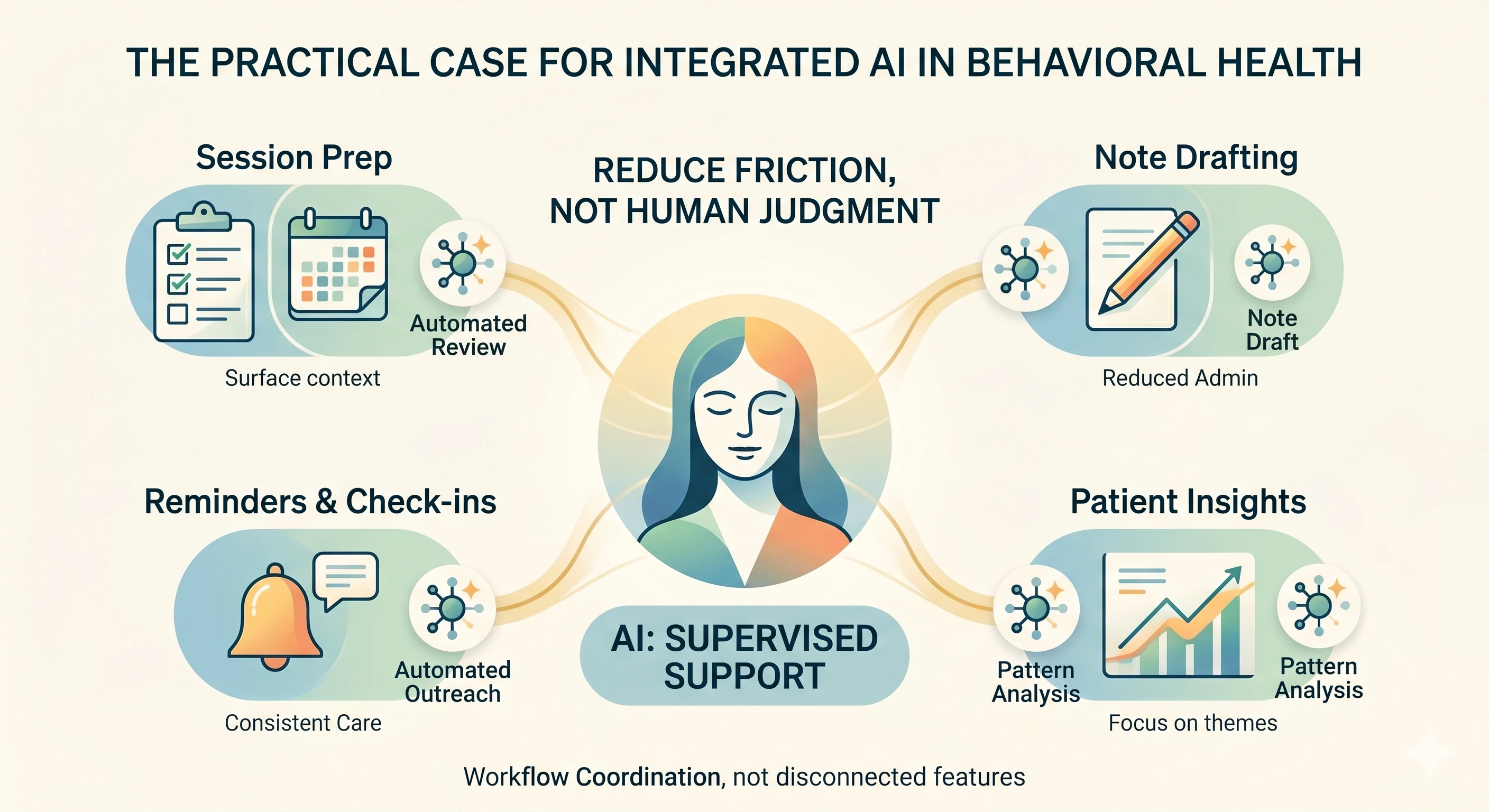
The strongest applications tend to sit in the background. They summarize patterns from completed assessments, surface relevant context before a session, help draft administrative documentation, and support timely reminders or check-ins. None of that changes the therapist’s role. It simply reduces the amount of clerical work required to deliver consistent care.
What good AI support looks like
A useful standard is simple: if the feature saves time while preserving therapist oversight, it is worth evaluating. If it asks clinicians to trust a black box with sensitive decisions, caution is warranted.
Pre-session preparation is one of the clearest examples. When a therapist can quickly review recent mood tracking, outstanding assessments, previous themes, and missed appointments in one view, the session starts with better context. AI can help organize that information and highlight changes worth noticing. The clinician still interprets what those changes mean.
Documentation support is another area with real value. Drafting summaries, pulling together patient-reported information, or turning structured data into a cleaner working note can reduce after-hours admin. The trade-off is that any generated content still needs review. In behavioral health, wording matters. A draft that is 80 percent right can still create risk if it includes assumptions, flattens nuance, or states something with more certainty than the session supports.
Patient engagement also benefits from thoughtful automation. Reminders, assessment prompts, and between-session check-ins can improve follow-through, especially for patients who struggle with consistency or motivation. But there is a limit. If outreach becomes too frequent or feels generic, it can weaken trust rather than strengthen it. Good systems support the cadence of care without making communication feel mechanical.
The difference between helpful AI and risky AI
Not every AI claim deserves equal confidence. In behavioral health, the line between support and overreach is easy to cross.
Helpful AI usually works with data the practice already collects and applies it to an operational task. It helps identify incomplete intake forms, prepare a concise session overview, route a patient questionnaire, or flag that a billing step is missing. These are bounded tasks. They are measurable, reviewable, and easier to govern.
Risky AI tends to present itself as more authoritative than it should. If a tool implies it can determine diagnosis, predict crises without clear limits, or produce treatment recommendations without sufficient clinical review, that is a serious concern. Behavioral health care depends on context that is often hard to capture fully in a data model. Human judgment is not a final checkbox. It is central to safe care.
This is why responsible positioning matters. Therapists do not need software that promises to replace their reasoning. They need software that helps them stay prepared, responsive, and organized across the full care journey.
What to ask when evaluating AI for therapists
A lot of therapy practices are not choosing between using AI and avoiding it altogether. They are choosing between embedded support inside a connected system and scattered features across multiple vendors. That changes the evaluation criteria.
Start with workflow. Where exactly will AI save time in the day-to-day operation of the practice? If the answer is vague, the value is probably vague too. A useful tool should map clearly to common pressure points like session prep, intake review, patient reminders, no-show reduction, assessments, and note support.
Then look at control. Can the therapist review, edit, or reject what the system produces? Oversight should be built in, not treated as a disclaimer. In clinical settings, convenience without control is not a benefit.
Privacy and data handling deserve the same level of scrutiny. Behavioral health data is especially sensitive, and clinicians are right to be cautious. Ask how data is processed, what is stored, what can be audited, and how permissions work across staff roles. Trust in AI is not only about the output. It is also about governance.
Integration matters just as much. If AI sits outside scheduling, billing, assessments, and communication, clinicians may end up doing extra reconciliation work just to use it. That defeats the point. The highest-value tools are connected to the operational system, because they can support continuity rather than creating another handoff.
Why connected care matters more than flashy features
Therapists rarely struggle because they lack one more feature. They struggle because their workflow is split across too many systems and too many manual transitions.
That is why the most effective use of AI in behavioral health is not standalone novelty. It is coordination. When scheduling, reminders, assessments, patient engagement, summaries, and billing live together, AI can support the flow between them. It can surface what needs attention before the therapist has to go hunting for it.
For a solo clinician, that may mean less evening admin and better visibility into patient follow-through. For a group practice, it may mean cleaner handoffs, more consistent intake, and fewer dropped steps across teams. In both cases, the value comes from continuity.
This is the practical case for platforms like enodoHealth. The workflow becomes more coherent when AI organizes defined information for professional review without substituting for professional care.
The real trade-off clinicians should consider
AI can absolutely reduce burden, but it also introduces a new responsibility: review. That is not a flaw. It is the right trade-off in behavioral health.
Clinicians should expect to verify drafts, confirm context, and make the final call on what belongs in the record or what should shape the next session. A good system shortens the path to those decisions. It does not remove the clinician from them.
Practices also need to think about implementation. Even the best tool can fail if staff are unclear on when to use it, what to trust it with, and what needs manual review every time. Adoption works better when the use cases are specific and the boundaries are clear.
The smartest path is usually incremental. Start with low-risk, high-friction areas like reminders, pre-session summaries, assessment follow-up, and administrative documentation support. Once the team sees reliable value there, it becomes easier to expand responsibly.
AI for therapists is most useful when it respects the reality of clinical work. It should reduce clutter, not create noise. It should support continuity, not fragment it further. And it should leave therapists with more time and clearer context for the one part of the job no system can replace - being fully present with the person in front of them.