
EnodoCare + enodoAlly: The Unified Future of Behavioral Health Management
Introduction
Behavioral health practices often experience their operational and clinical work as two separate worlds. One world handles scheduling, billing, reminders, and forms. The other handles notes, patient engagement, outcomes, and the work of understanding change over time. When those worlds are split across disconnected systems, the practice feels busier than it should.
That fragmentation affects more than convenience. It affects follow-through, staff coordination, and clinical visibility. A clinician who has to search across tools for context is working with less clarity than one who can see the operational and clinical picture together.
The idea behind EnodoCare and enodoAlly is that these two sides of the practice should reinforce each other. Operations should make care easier to deliver, and clinical information should be easier to act on because it lives inside the same connected environment.

Why Unified Matters
When practice systems are disconnected, every workflow becomes heavier:
- appointment activity does not naturally inform clinical preparation
- documentation may sit apart from patient engagement
- assessment results can be delayed or underused
- staff and clinicians spend time reconciling records instead of using them
The result is not just inefficiency. It is a weaker ability to notice patterns, respond early, and keep the patient journey coherent from intake through ongoing care.
Unified systems matter because they reduce that translation layer. The practice no longer has to constantly move information from one context to another.
What EnodoCare Handles
EnodoCare addresses the operational foundation of the practice. That includes the workflows that determine whether the day runs smoothly or constantly requires manual intervention.
This includes:
- scheduling and rescheduling
- waitlist management
- billing and invoicing
- practice-level administration
- the secure movement of operational information
These functions are essential, but they are often treated as separate from care. In reality, they shape the patient’s experience and the clinician’s capacity. Clean operations reduce avoidable friction for everyone involved.
What enodoAlly Adds
enodoAlly extends the system into the clinical engagement layer. This is where the platform becomes more than a practice management tool and starts functioning as a continuity tool.
That layer can support:
- between-session patient engagement
- assessments and progress monitoring
- AI-assisted documentation workflows
- visibility into patterns that would otherwise stay buried in separate notes or check-ins
This is important because many meaningful clinical signals do not appear clearly inside a single appointment. They emerge across time, between sessions, and across different types of interaction.
Why the Combination Is Stronger
Either side alone solves only part of the problem. Operations without engagement still leave the clinician with weak visibility between sessions. Engagement without operational integration still leaves the practice carrying workflow sprawl.
Together, EnodoCare and enodoAlly create a single source of truth that can support both coordination and care. That combination makes several things easier:
- the clinician can prepare with fuller context
- the practice can reduce duplicate entry and handoffs
- patient activity can connect more naturally to documentation and follow-up
- outcomes tracking can inform treatment instead of living in a separate silo
That is the practical meaning of a connected, proactive workflow.
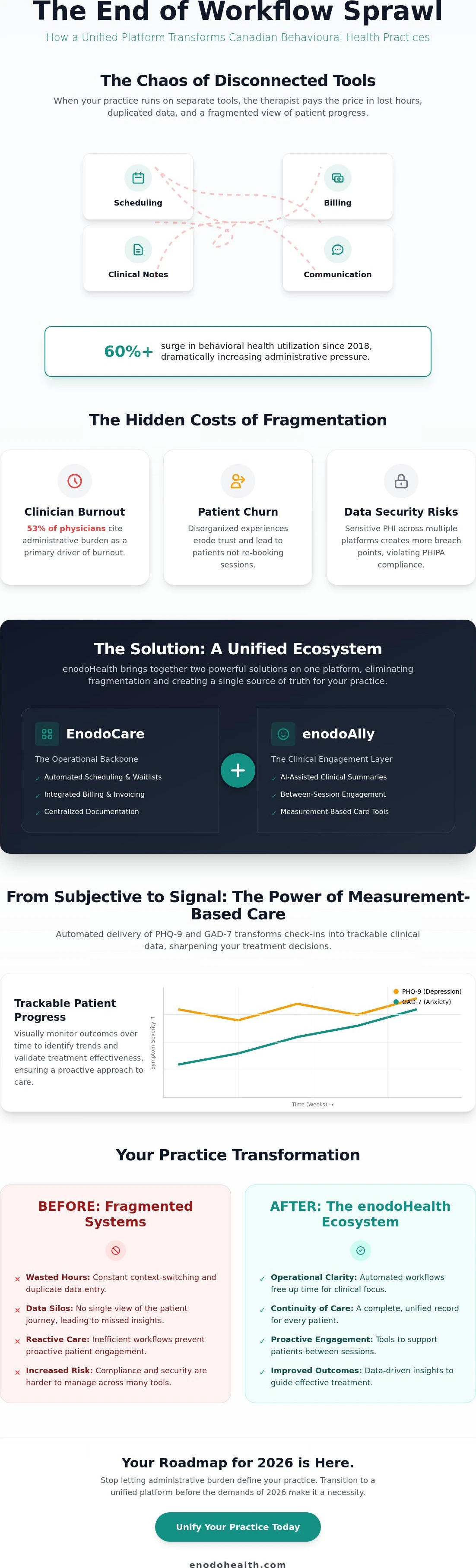
Measurement-Based Care Inside a Unified System
Measurement-based care is often treated as an extra layer that practices should add when they have time. In reality, it becomes much more feasible when it is built into the same environment as documentation, patient communication, and clinician review.
When assessments are connected to the rest of the system:
- delivery is easier to automate
- results are easier to review before or during sessions
- longitudinal trends become easier to interpret
- treatment adjustments can happen with better evidence
This is where unification matters most. Clinical signals are more useful when they are not trapped in isolated forms or external trackers.
What This Means for Practices
For solo practices, a unified system can reduce the constant switching between administrative and clinical tasks. For group practices, it can create stronger consistency across staff, more reliable reporting, and a clearer view of how patients move through care.
In both cases, the goal is the same: fewer fragmented workflows and better visibility into what the practice is doing, how patients are progressing, and where follow-up is needed.
That is also what makes adoption more sustainable. Staff do not need to memorize a maze of disconnected products. They can work inside one environment that reflects how the practice actually operates.
Conclusion
The future of behavioral health management is not just more software. It is better connection between the software functions a practice already depends on. EnodoCare and enodoAlly point toward that model by bringing operations, patient engagement, documentation, and outcomes visibility into one system.
The value of that approach is straightforward: less workflow sprawl, stronger continuity, and a better foundation for proactive care.